CASE STUDIES
OUTER CIRCLE PEDESTRIAN CROSSINGS,
Crown Estate Paving Commission
Design, Procurement and Construction Management, 2025
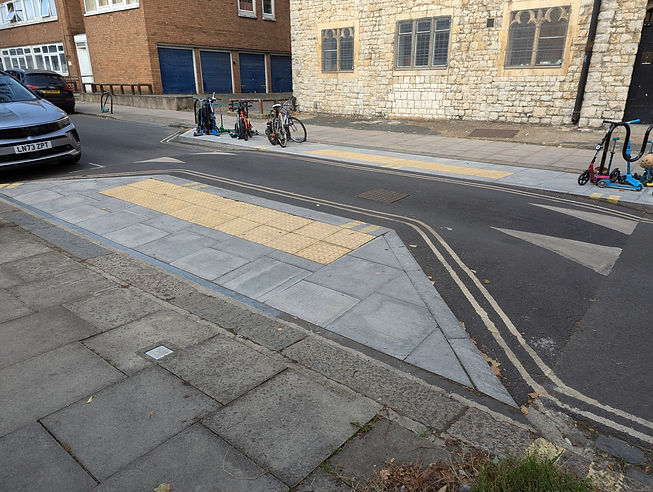
Following a fatal collision between a cyclist and an elderly pedestrian at an uncontrolled crossing at Kent Passage, concerns were raised about the safety of crossings along the Outer Circle in Regent’s Park. The incident highlighted the risks posed by high cyclist speeds particularly at locations with no formal crossing controls. The Royal Parks and the Crown Estate Paving Commission sought to implement safety improvements at Kent Passage, Monkey Gate, and Chester Gate to prevent further incidents.
Our Approach
RCL was appointed to develop design proposals for safer pedestrian crossings at the three locations. Building on preliminary layouts prepared by others, we:
• Conducted a rapid assessment of the site context and reviewed available speed and collision data.
• Proposed signalised pedestrian crossings at each location, balancing safety needs with heritage and operational constraints.
• Coordinated with lighting and signal specialists to ensure the designs could be delivered without requiring TfL adoption or intervention.
• Provided phased feasibility layouts, programme advice, and implementation strategies to meet the client’s ambition to begin works by Autumn 2025.
Outcome
The client has adopted RCL’s recommendations to implement signal-controlled pedestrian crossings at Kent Passage, Monkey Gate, and Chester Gate. The schemes are progressing through detailed design, with a target to commence construction in Autumn 2025. The interventions are expected to significantly reduce the risk of pedestrian-cyclist conflict and enhance safety in a high-profile, heavily used public space.


W3 & 41 BUS ROUTE IMPROVEMENTS,
London Borough of Haringey
Feasibility Study, 2024
The London Borough of Haringey (LBH) sought to address growing concerns around bus service reliability and journey time delays along Routes 41 and W3. These east-west routes are critical to local connectivity, yet performance was being affected by congestion, infrastructure constraints, and the implementation of Low Traffic Neighbourhoods (LTNs). LBH required a feasibility study to:
• Identify the causes of delays and reliability issues.
• Recommend interventions that would improve bus performance.
• Support broader policy aims of reducing car dependency and improving sustainable transport.
Our Approach
Roadways Consulting Ltd (RCL), working in partnership with Eagle Nine Ltd, delivered a structured, data-driven approach:
• Conducted a rapid assessment of the site context and reviewed available speed and collision data.
• Data Collection & Analysis: Leveraged iBus data across 2018, 2023, and 2024 to analyse journey times, dwell times, and delay variance between stop pairs.
• Stakeholder Engagement: Consulted with LBH officers, TfL, councillors, and bus operators to gather local insights and align proposals with experiences.
• On-Street Observations: Carried out detailed walking audits and peak-time bus journeys across both routes, supplemented by video surveys.
• Design Development: Mapped out congestion hotspots and developed outline and concept design proposals supported by RAG-rated assessments of feasibility and impact.
Key Achievements
• Over 120 stop-pairs analysed using three years of iBus data for robust, time-sensitive diagnostics.
• 13 congestion hotspots mapped and assessed, with interventions categorised by feasibility, impact, and risk.
• Multi-stakeholder engagement delivered across council, TfL, and operators, ensuring proposals had broad support and operational credibility.
• Delay variance methodology introduced to LBH, providing a replicable analytical framework for future studies.
QUEENS CRESCENT LOW TRAFFIC NEIGHBOURHOOD,
London Borough of Camden
Construction Package, 2023
The London Borough of Camden sought to implement traffic calming and public realm improvements in the Queen’s Crescent area as part of its Low Traffic Neighbourhood (LTN) programme. The aim was to reduce through-traffic, enhance pedestrian and cyclist safety, and encourage sustainable travel modes.
Feasibility layouts had been developed in-house but required a competent design team to take the proposals forward to construction-ready detail.
Our Approach
Roadways Consulting Ltd applied a structured and collaborative methodology to deliver construction-ready designs for Camden’s Low Traffic Neighbourhood scheme. This included verifying site conditions, coordinating utility information, and developing preliminary layouts that addressed drainage, visibility, and speed reduction. The team progressed the designs to detailed construction drawings, incorporating Road Safety Audit feedback and ensuring CDM2015 compliance. All outputs were independently reviewed for quality and submitted in a clear, buildable format aligned with local authority standards.
Outcome
Delivered construction-ready design packages across four urban sites, including raised tables, width restrictions, and public realm enhancements.